

AI can write emails, generate images, analyse data and finish tasks that used to take people hours. So if you work at a desk, it is fair to wonder: is my job next?
If you have ever searched for AI-proof jobs, or caught yourself wondering which careers are safe from AI, you are far from alone. Millions of people are asking the same question, and many are now thinking about a change of direction.
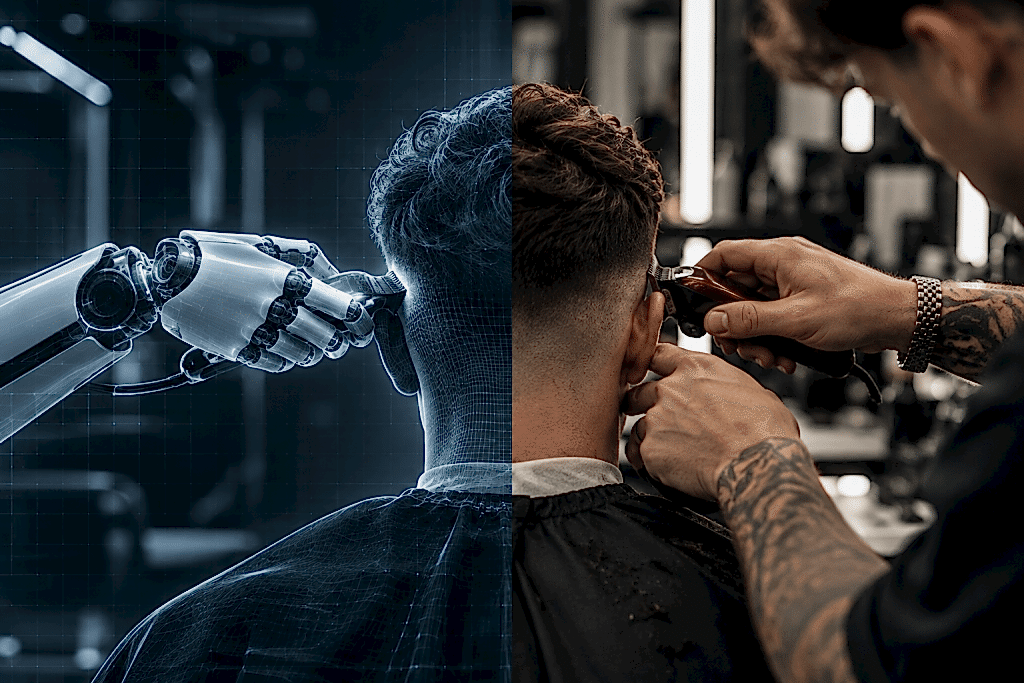
Here is a different way to look at it. Barbering is a real trade, done with your hands, on a real person, in the real world. And that makes it much harder to automate.
Which jobs are actually safe from AI?
No career can be promised as completely AI-proof forever. Technology will keep developing, and almost every industry will keep changing.
But some jobs are far more exposed than others. The work AI does best happens on a screen: writing, summarising, sorting data, answering routine questions. Jobs built on physical skill, judgement and face-to-face trust are much harder for it to reach. Barbering is one of them.
Why barbering is different from a desk job
Barbering is fundamentally different from screen-based work.
A barber has to assess the person in the chair, understand their hair, talk through what they want, decide on shape and technique, then physically carry out the cut. That takes hand-eye coordination, precision and constant small adjustments.
You can ask AI how to create a fade. It still cannot stand behind the chair and deliver one.
What the research says about AI and barbering
Studies of how AI affects different jobs keep reaching the same conclusion: the tasks most exposed are screen-based ones, and the tasks least exposed are those that need physical presence and interaction with the real world. Most of what a barber does falls into that second group.
That does not mean technology has no place in the industry. AI could help with bookings, stock ordering, marketing, social media, customer messages and business admin. But helping a barber run their business is very different from replacing the barber.
The barbering skills AI cannot easily replace
A great haircut takes far more than knowing which guard to use. It combines practical skills that grow through training and experience.
Precision and control
From a smooth fade to scissor work, a barber needs coordination, accuracy and control. These are physical skills that improve through repetition and practice.
Understanding hair and head shape
Knowing how hair grows, where the weight sits and how different shapes change the finished result lets a barber make the right decision for each client.
Creativity and problem-solving
Not every haircut follows a formula. Barbers use their knowledge of technique and shape to create styles that suit the individual, and adjust when something does not go to plan.
Consultation and communication
Understanding what a client wants is as important as knowing how to deliver it. A good consultation turns a rough idea into a realistic plan.
These skills work together every time someone sits in the chair. And you cannot learn them by reading instructions alone.
Why the human side of barbering matters
Think about why people go back to the same barber. It is trust. Their barber knows how they like their hair, remembers what worked last time and makes them feel comfortable in the chair.
That relationship is a big part of the industry. Clients want someone who listens, understands their preferences and gives honest advice when they are unsure what to ask for.
Technology can make booking easier. It cannot replace sitting with a barber who knows your hair.
Worried about losing your job to AI? Barbering as a career change
If your role is changing, or you are worried it might, learning a hands-on skill gives you a different kind of security. A trade is not tied to one employer, one piece of software or one screen.
Barbering also gives you choices. You can work in a barbershop, become self-employed, build your own client base, rent a chair, or one day open your own shop. Our graduates have taken all of these routes. If you are weighing it up, read why barbering is the right career change for you (https://karrookenner.shop/why-barbering-is-the-right-career-change-for-you/) and see how LSB graduates have gone on to own their own shops (https://karrookenner.shop/from-student-to-shop-owner-success-stories-from-lsb-graduates/).
You do not need any experience to start. Our beginner courses are built for people who have never picked up a pair of clippers.
How to become a barber with London School of Barbering
The first step is building the practical skills the industry relies on. At LSB, training is built around learning by doing.
Students begin with the fundamentals, watching live educator demonstrations and learning the technique behind each cut before they practise it. As their skills grow, they move on to working with real clients, adapting to different hair types, growth patterns, head shapes and requests. Experienced educators give guidance and feedback throughout, so you build the control, confidence and consistency you need behind the chair.
LSB students can complete approximately 80 to 100 real client cuts during their training, which means real experience before you enter the industry.
For complete beginners, there are two main routes:
- 9 Week Beginner to Job Ready: focused, practical training that builds the essential skills and works towards a Level 2 NVQ qualification.
- 12 Week Beginner to Master: more time to develop advanced techniques, creativity and confidence, working towards Level 2 and Level 3 NVQ qualifications.
Cannot train Monday to Friday? We also run weekend and evening courses, and you can spread the cost with our payment plans (https://karrookenner.shop/barber-course-financing/).
Frequently asked questions
Can AI replace barbers?
Not any time soon. Barbering relies on physical skill, judgement and personal interaction, which are the things AI struggles with most. AI may help with bookings and business admin, but it cannot cut hair.
Is barbering an AI-proof career?
No career can be guaranteed AI-proof forever, but barbering is much less exposed than most screen-based jobs because the work is hands-on and happens in person.
What jobs are safe from AI?
Jobs built on practical skill and human contact are generally harder to automate. That includes skilled trades and personal services such as barbering.
Is barbering a good career change if I am worried about losing my job to AI?
It can be. It is a transferable, hands-on skill with several routes: working in a shop, going self-employed or opening your own business. You can start with no previous experience.
How long does it take to train as a barber?
At LSB, our beginner courses run for 9 or 12 weeks, with longer Saturday and evening options if you work or study during the week.
Your future in barbering starts here
AI is changing the way we work, and that will not stop. But barbering is built on something technology still struggles to copy: hands-on skill, creative judgement and real human connection.
If you want a career built on practical skills, now is the time to start. London School of Barbering runs courses in London and Manchester, so you can begin your training close to home.
Learn the fundamentals, build real client experience and take the first step from complete beginner towards a professional career.
Explore our 9 and 12 Week Barbering Courses and secure your place today.